Showing posts with label History. Show all posts

Sunday, April 21, 2019

Easter Excursion Day 2 - Naworth Castle and Lanercost Priory

On September 10, 1649, a twenty-seven-year-old Anne Murray—known to us by her married name, Anne Halkett—left London for Naworth Castle, where she stayed nine months. Naworth Castle was then the home of the twenty-one-year-old Charles Howard and his wife and cousin Anne Howard, Halkett’s childhood friend. (How convenient not to have to change your last name when you get married!)

Charles Howard
According to the Oxford Dictionary of National Biography (and Wikipedia), Charles Howard successfully tacked with the changing political winds of the tumultuous 17th century. He was brought up as a Catholic and sided with Charles I during the English civil war, but then “distinguished himself” in battle on Cromwell’s side and served in parliament during the interregnum. After the restoration of Charles II, he was knighted and appointed ambassador to Russia, and then governor of Jamaica. By the end of it all he had amassed a fortune large enough for his grandson to build the palatial Castle Howard.

Today the 14th-century Naworth Castle is still in the Howard family, serving as the residence of Philip Howard, the second son of the twelfth Earl of Carlisle.


This means, unfortunately, that it is not open to the public, unless you can afford a private guided tour. But since the castle is just down the road from where we were staying, we decided to get as close as possible on our return from Housestead's Roman Fort. Here are the castle's front gates, both ancient and modern:

Since we qualify as the "public," we continued down the lane (driveway?) past the castle, where I took another photo:

The castle website—still under construction after all these years—does have a few nice pictures of the interior.

We were looking for the public footpath that runs through the back of the Howard estate where we hoped to getting a better view, but the footpath we chanced upon once we located a "car park" took us along the other side of the River Irthing to the ruins of Lanercost Priory:

The vicar of the Priory Church is a shepherdess. I wonder, are these her sheep?

We decided against paying the fee to see the English Heritage section of the Priory ruins, and entered the restored part of the 12th-century church instead, where we were treated to the equivalent of a free guided tour.

In brief, the Parish Church of St. Mary Magdalene and adjoining Augustinian Priory were built in the 12th-13th centuries at least partly out of stones from Hadrian’s wall. (This is apparently common in Cumbria. Our “guide” explained that you can tell Hadrian’s wall stones both from the colour of the local stone and the size: they had to be small enough for Roman soldiers to carry one at a time.) King Edward I made the Priory his home in 1306-7 when he tried to conquer Scotland; in 1538 the Priory was dissolved by Henry the 8th, and both Church and Priory were mostly left in ruins. Unlike Leicester Abbey, these ruins survive, and unlike the rather thorough iconoclasts in our area, the Cumbrian reformers missed a statue:
In 1649, when Lady Halkett visited Naworth Castle, the local parish church met in the old church's north aisle. I am given to understand, however, that she most likely attended services in the Castle’s private chapel, which had its own Anglican chaplain at a time when the Anglican order of service was proscribed from use in local churches. For some reason, the list of Lanercost ministers has a gap between 1637 and 1651, so we don’t know who would have officiated if she did visit the old Priory.

The nave of the old church was re-roofed in the 18th century, and then beautifully restored in the 19th by George Howard, the 9th Early of Carlisle, and his Pre-Raphaelite friends, Edward Burne-Jones and William Morris. (I do regret not paying the requested £1 donation so that I could take pictures of the restored church’s beautiful interior, but you can sample Google’s offering here.)

Of greater interest to us at that moment was the walking map our guide produced, indicating the public footpath that might have afforded us a better view of Naworth Castle. Alas, by the time we had rested our feet by the old Lanercost bridge and helped rescue a wandering puppy ...

... there arose a protest against venturing any further.


Sunday, August 12, 2018

Leicester City

Our destination on day 2 of our weekend car-rental excursion was the city of Leicester. Today Leicester is probably best known for the Leicester City Football Club; we were interested in something a little more medieval.
We began our visit with a rainy walk through Abbey Park ...
 ... which turned out to be the highlight of the day.

Abbey Park takes its name from the Abbey of Saint Mary de Pratis, an Augustinian monastery that was dissolved in 1538 by order of Henry the VIII and quickly dismantled. Even the stone from the foundations was removed and reused in other buildings. The complex was so thoroughly obliterated that until archaeological excavations in the early 20th century, no one knew where precisely the abbey had been located. The low walls that now stand in the park were built by archaeologists in the 1930's to mark their findings. t. was happy to chance upon the modern memorial to Cardinal Wolsey, who fell out of favour after failing to secure a divorce for Henry the VIII. Wolsey died in 1530 on his way to London to face trial for treason. We know he was buried at the abbey, though his tomb was never found. (We neglected to take any other pictures of the abbey ruins. Blame the rain.)

Abbey Park also includes the ruins of Cavendish House, a mansion built in the early 17th century using stone from the abbey ruins. Christiana (Bruce) Cavendish, the Countess of Devonshire--and, more importantly, Lady Anne Halkett's godmother--took ownership of the mansion in 1628 after her husband died. In 1645 the mansion was burned by retreating royalist troops during the English civil war.

We didn't let the rain ruin our day:
Lunch at the Peppercorn Cafe

Tourism in Leicester received a boost in 2012 when the remains of the last Plantagenet king, Richard III (1452-1485), were discovered in a "car park" behind a building near what is now Leicester Cathedral.
Richard was killed in the battle of Bosworth Field, and his successor, Henry VII, the first of the Tudors, saw no reason to honour his predecessor's legacy. In 2015 bad king Richard at last received a royal funeral, and was re-buried in Leicester Cathedral:
While it is a medieval church, it was only designated a cathedral in 1927, and is tiny in comparison to the Norman cathedrals we visited in Ely and Norwich:
We found both the tomb and the cathedral underwhelming, and decided to take a pass on the Richard III visitor centre, and the chance to see where Richard's bones were discovered. (If you are interested in more detail, you might find "The King in the Car Park" documentary entertainingly absurd, says t.)

On our way out to our own car park we stopped in at the remains of a Roman bathhouse:
(The soldiers are not original.)

Friday, April 20, 2018

Martyrdom and Motivation: Robert Falcon Scott, Roald Amundson, and the Cambridge Polar Museum

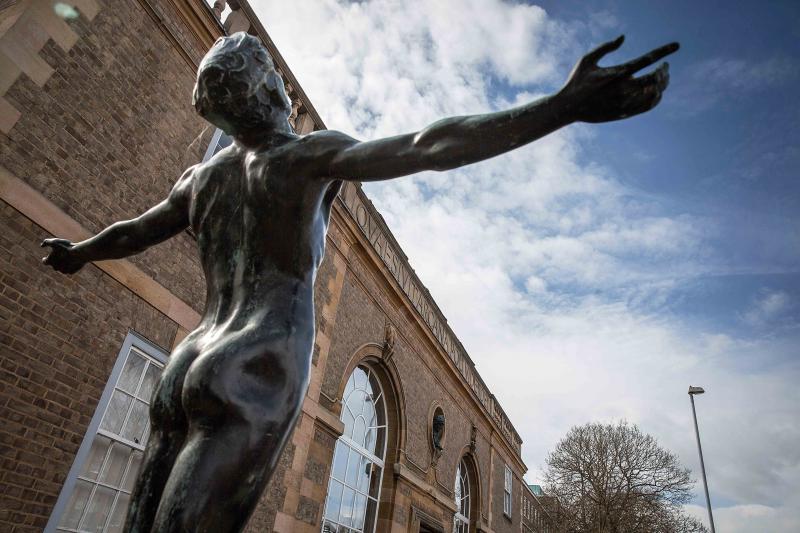
"Youth" by Kathleen Scott
My daughter and I took an Easter break outing to The Polar Museum at the Scott Polar Research Institute last week. The Institute takes its name from Robert Falcon Scott, who arrived at the South Pole on 17 January 1912 only to find that the Norwegian explorer, Roald Amundson, had got there 34 days before him. The bodies of Scott and his companions were found on their return journey just 11 miles from a cache of food and supplies. Scott's diary, discovered at the site, chronicles the ill-fated expedition's harrowing final days, and concludes with the plea "for God’s sake look after our people."

It was a bit odd, I thought, to name a research institute after an explorer who came in second and who did not live to tell the tale. But when the diary was published it caused a sensation. So much money poured in to "look after our people" that some was set aside to found the institute. The story about the heroic explorers was used to drum up support for the first world war. Perhaps it is no coincidence that the Scott Polar Research Institute was built right beside the church of "Our Lady and the English Martyrs" or that a sculpture donated to the institute by Scott's widow, Kathleen, looks rather like a crucifix. 

Scholars debate why Scott failed and Amundson succeeded, but the museum keeps it simple, explaining that Amundson beat Scott to the South Pole because he had only one goal--to be the first one to reach the South Pole--and he pursued it single-mindedly. I'm sure there's a lesson there somewhere...

(In case you are wondering, s. enjoyed sitting by the Cam and feeding swans much more than the museum.)

Cross-posted on gervatoshav.

Saturday, April 7, 2018

London

London is a bagpiper playing AC/DC's Thunderstruck outside Westminster Abbey. (Sorry, no picture. I was trying to figure out how to get into the Abbey.)

Westminster Abbey is for those who don't mind long lines and lots of people. Once we were through security, we eventually discovered we could jump the entrance queue because we had purchased our tickets online the night before.

Inside, it helps to think of the edifice as a church and a church yard all under the same roof. There is a lot to take in, from the medieval building itself to the effigies of dead monarchs, and plaques memorializing other famous British notables. The audio guide, narrated by Jeremy Irons, helped us make sense of some of it, and--more important still--kept even our junior member moving through the building with interest. A highlight for s. was chancing upon the grave of Muzio Clementi, a composer her piano teacher had her read about. Like John Wesley, I was struck by Roubiliac's sculpture of Lady Elizabeth and Joseph Nightingale. I was also pleased to see a memorial to the historian brothers, Henry and Owen Chadwick. (No pictures because photographs are not permitted inside the Abbey.)

From the Abbey we made our way along St. James' Park to Trafalgar Square and the National Gallery.

A. wanted to see WhistleJacket:
 The best part of London, from s's perspective ...

... was seeing several new varieties of waterfowl in St. James' Park:

Wednesday, April 4, 2018

Hatfield House


It's Easter break here and we have a family visitor, which is excuse enough to go sight-seeing. On Monday we took the train to Hatfield, site of the palace where Queen Elizabeth I was raised. The Hatfield estate passed into the Cecil family when Elizabeth's successor, James I, traded the property to Robert Cecil, the first Earl of Salisbury, sometime chancellor of the University of Cambridge, secretary of state under both Elizabeth and James, and knight of the Order of the Garter. Sir Robert was also chief spymaster to Elizabeth, which might account for the eyes and ears on her dress:
Robert, who looked to the future instead of attempting to preserve the past, demolished most of the Old Palace and used its bricks to build Hatfield House (pictured above). The surviving wing of the palace was used as a stable for the next three hundred years. The original 16th-century roof of the great hall is indeed impressive...
... but to view it, visitors must listen to a 45 minute "historical" talk about Henry the VIII's marital life and the accession of Elizabeth. S.'s verdict was "Interesting!" The rest of us wished we had spent our time contemplating the palace's exterior:
Sir Robert's gardener, John Tradescent, was important enough to merit his own carving at the top of the original 17th-century great staircase (as well as his own Wikipedia entry):
The present gardens have apparently been restored to follow Tradescent's design:
 Where's Waldo s.?
 The interior of Hatfield House is impressive too:


I especially liked the library:

Unfortunately, Robert did not live to enjoy it. Hatfield House was completed in 1611. Robert died in 1612, aged 48. According to Wikipedia, the cause of death, was overwork ... and cancer.


From t.'s perspective, Hatfield House is another supposedly fun thing she'll never (willingly) do again. But if you can get beyond the pricey admission rate, the general herding mentality, and the cheap popular drivel presented as "history," there is still lots to see, and we may all, in time, be glad we did.

For my part, I find that the immersive "being there" experience contributes a lot to a historical education.

And did I mention the library?

Saturday, February 24, 2018

Edinburgh Day 4: Adrift

We had six hours to kill in Edinburgh after checking out of our hotel on Sunday morning. We began with a bus ride to the National Library, and walked from there to Edinburgh Castle so that t. could get a closer look. From there we took the path down and around the bottom of the castle rock, accompanied by our extra roller bag, whom we christened "Bob the bag."
I regret to say I didn't take any pictures of Bob, but here is one of s. contemplating an assault on the castle:
It was too cold to spend the whole morning outside, so we migrated to the nearby Scottish National Gallery, where Bob took a nap in a locker, and the rest of us, respectively, sat and read, sat and knitted, and looked at paintings.

From there we walked to the Scottish National Portrait Gallery, which was more to our taste. t. and I found the 16th-18th century exhibits fascinating, though Bob, weary from the journey, took another locker nap, and s. was content to read:

When I read this quote by E.J. Hobsbawn about the early 20th century, I wondered if it will also be asked of the 21st:
We stopped in the Waverley Station mall for lunch, and then caught a very crowded train back to Cambridge. Note for next time: Don't book a train for the last day of half-term break.

Sunday, December 10, 2017

Highlights from the British Museum

We made it out to the British Museum last weekend, enjoying our first London Tube ride in situ along the way. S., along with a crowd of other people, was excited at the prospect of seeing the archaeological discovery that enabled scholars to decode Egyptian hieroglyphs:
The Rosetta Stone, British Museum,
After visiting Athens in 2013, I wanted to see the Elgin Marbles that used to adorn the Parthenon. (At the beginning of the 19th century, Lord Elgin received permission from the Ottoman government to take away "pieces of stone with old inscriptions or figures thereon." The priceless rock he carted off surely exceeded what the Sultan had in mind.)

The Egyptian exhibits were stunning, as one would expect:
Amenhotep III's left arm

But I was most surprised and astounded by the Assyrian artifacts. Here, for instance, is a Lamassu from Khorsabad that apparently goes back to the reign of Sargon II in the late 8th century BCE:

More exciting still is a series of wall panels depicting Sennacherib's siege of Lachish in 701 BCE:
Sennacherib's capture of Lachish is mentioned in Isaiah 36:1-2; it is also described first-hand in a series of letters inscribed on ostraca that were discovered when Lachish was excavated in the 1930's.

On a final dash through the second floor, I snapped pictures of various 1st-century Roman emperors for use in class:
The Emperor Augustus

If it were not for the incentive of seeing real mummies...

... we would have missed the Cyrus Cylinder, which describes Cyrus's policy of repatriating subject peoples to their homelands:


Admission is free, so it is churlish to complain that the museum is simply too large to take in on a single visit. The contents could easily be divided into a half-dozen world-class museums. 
I guess that means I'll need to go back.